
上锁的房间
China’s deep-processed agri-goods fuel higher-value trade growth_我的网站

A |
Chinese plush toys, new-energy vehicles and robots often grab global headlines. Beyond the spotlight, however, many unassuming Chinese exports are quietly making great gains in markets around the world.
Recently, 14,040 specific pathogen free (SPF) eggs, also known as "diamond eggs" and prized as a critical raw material for vaccine research, took off from Beijing Daxing International Airport and landed in Riyadh, Saudi Arabia.
In the first half of 2026 alone, exports of Beijing-produced SPF eggs topped 400,000 units, soaring 254 percent year-on-year. Their export value exceeded 3.8 million yuan ($563,364), up 166 percent year-on-year. Both figures already surpassed the full-year total for 2025, according to statistics from the Beijing customs.
"Diamond eggs" are not alone. Many processed farm goods from various regions across China, ranging from loofahs to new corn-based synthetic fibers to "icy persimmons," are reaching consumers in many countries and regions around the world, with rising export volumes.
Behind the headline numbers lies a quiet change: China is no longer content to ship out raw apples, live fish, or unprocessed grain. It is climbing the value chain - turning farmyard staples into high-value, shelf-ready products for markets around the world, Zhu Qiucheng, CEO of Ningbo New Oriental Electric Industrial Development, told the Global Times.
New e-commerce stars
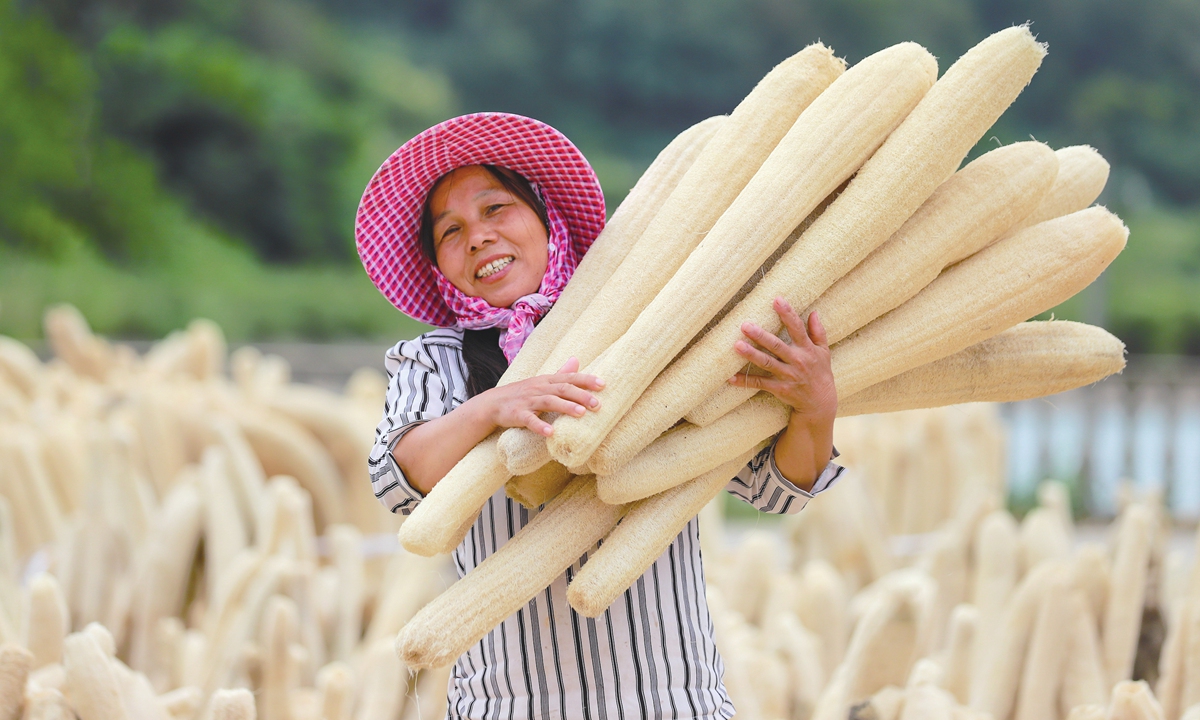
In Shangcheng County, Central China's Henan Province, the loofahs once lived a quiet life next to the stove - serving as kitchen scrubbers. Today they are a cross-border e-commerce star.
"We have built processing factories, design teams and unified procurement systems that link agricultural cooperatives and farmers across dozens of villages, turning sponge gourds - a traditional side crop - into a scalable, export-oriented industry," a sales manager at Yuangeng Longshang, a local producer and exporter of sponge gourd-related products, told the Global Times.
Processors in Shangcheng have developed more than 60 loofah product lines - ranging from bath sponges and kitchen scrubbers to pet toys and cultural-creative items - and sell them via Amazon, AliExpress, Temu and other platforms to more than 50 countries and regions, according to media reports.
In the first half of 2026, Shangcheng's e-commerce transaction volume of loofah-made products exceeded 30 million yuan, up 35 percent year-on-year. At present, the annual comprehensive output value of the loofah industry in the county has exceeded 100 million yuan.
Apart from sponge gourds, corn has also found a new way to become cloth.
"Unlike traditional synthetic fibers made from petroleum, the core ingredient of our flagship Sorona-based series comes from corn," Hong Boqi, general manager of Chuanyue New Material Co, a domestic cloth supplier, told the Global Times.
The process of making Sorona starts by fermenting corn sugars to extract Bio-PDO (a bio-based chemical building block, essentially a plant-derived version of the molecule used in certain plastics). This is then polymerized and spun into yarn and finished fabric.
The company has independently developed more than 300 Sorona fabric varieties, said Hong.
The firm is also exploring seaweed. Working with a domestic biotech partner, it created an "ice algae mud" functional fabric. Natural seaweed is finely ground and combined with a composite powder made from nephrite, then processed through a specialized spinning method. The finished textile is designed for recycling, reinforcing its green credentials.
Behind these advances lie years of patient research and development. Chuanyue invests about 4 million yuan annually in early-stage material development, covering the full journey from lab innovation to finished fabric, said Hong.
Innovative ways
Apart from being processed into industrial products, Chinese fresh fruits and vegetables are also processed in innovative ways to reach global consumers.
For example, Hainan Nicepal Industry Co is not simply selling fresh fruit. Instead, it uses advanced spray-drying technology to turn fresh fruits into fruit powders, concentrated juices, and not-from-concentrate (NFC) purees.
Pan Fengying, deputy general manager of the Hainan-based company, said that the company's output value reached 600 million yuan last year, and this year's target is 1.2 to 1.5 billion yuan, according to local media.
And in Yi County, North China's Hebei Province, fresh fruit that once spoiled quickly or fetched rock-bottom seasonal prices is now processed into "icy persimmons," which made exports easier.
In April 2026, the first batch of 15,000 persimmons was sent to Toronto, Canada. In the first half of this year, the sales volume of the ice-ripened persimmons in the county increased eightfold compared to the previous year; the annual production is expected to be 20 times that of last year, local authorities said.
Through controlled processes of de-astringency, sugaring and rapid freezing, the fruit develops a creamy, ice-cream-like texture while retaining its natural sweetness. Local authorities built a shared industrial park complete with standardized workshops, fully automatic production lines and large-scale intelligent cold storage, allowing micro- and small-sized firms to "move in without having to prepare for everything."
The China Agricultural Sector Development Report 2026, released in June, projected a pivot toward higher-value agricultural exports from 2026 to 2030. Categories such as processed fruits and nuts, frozen fruits, fish fillets and frozen vegetables are flagged for strong growth potential.
The message is clear: volume still matters, but value and differentiation matter more.
How did the "sudden" upgrade of the agricultural sector happen? Analysts pointed to two major reasons: pursuit of high-quality development and resilient supply chains.
China has emphasized high-quality development, guiding enterprises to focus more on quality over quantity. This has led to deep processing, brand building and new quality productive forces in the agriculture sector, said Zhu.
Zhu also noted that the speed and completeness of China's resilient supply chains are powering the transformation. Every link - from raw materials to finished goods, including processing, packaging, and logistics - is tightly connected.
。
目前,印度的大选正在“火热进行”,将会一直持续到6月1日。
这场大选也将决定“莫迪老仙”能否“三连任”,开启下一个5年任期。
有意思的是,在这个对于莫迪而言最为重要的时刻,被印度人视为“印太盟友”的美国却跑出来给印度泼了盆冷水:“你们的美梦该醒了!”
近些年来,中国经常被拿来和印度做比较,说中国能完成经济腾飞,全靠人口红利,印度人口同样多,而且更为年轻,又是“世界上最大的民主国家”,将来肯定成超越中国。

B |
而印度每年6%到7%的经济增速也给了印度人极大的信心,自以为“赶中超美,指日可待”。

C |
而且如果经常观察印度人在社交平台上发言的话会发现,他们将印度经济增速都归因于了莫迪:“是伟大的莫迪带领印度实现了经济神话,因为万恶的国大党,我们印度丢掉了数十年的发展机会!”
甚至,骄傲的印度人还曾经对外放出豪言壮言,说印度将会在2020年成为“超级大国”。
虽然2020年时的印度距离超级大国还有“小小的差距”,但这不妨碍印度人继续自吹自擂。

D |
就事实而言,印度的经济增速根本称不上什么奇迹,因为印度经济的体量摆在那里。
举个例子,2022年中国GDP 约为18万亿美元,2023年同比增长5.2%。

E |
2022年印度GDP则约为3.4万亿美元,2023年同比增长7.7%,虽然看起来比中国多了2%,但中国GDP的规模是印度的5倍以上。
也就是说,除非此后几十年里,中国经济原地踏步甚至陷入负增长,与此同时印度经济增速像当的中国一样数十年维持在二位数,这样一来,印度才有那么一丝赶超中国的希望。
这个道理除了印度人自己,全世界都很清楚。但美西方为了挑逗印度跟中国作对,就一个个的跟印度唱赞歌,让印度沉浸在了成为超级大国的美梦之中。
有意思的是,2024年的今年,美国、英国似乎都不想再给印度唱赞歌了,想让印度“清醒清醒”。
美国《时代周刊》杂志网站发表了一篇署名为德巴什·罗伊·乔德里的评论文章,文章题目为《莫迪治下印度经济的真实表现》,内容对印度可以说一点都不客气。
“在莫迪政府不遗余力的粉饰和包装之下,印度经济增长被包装成了所谓的‘新经济奇迹’,看起来莫迪似乎已经完成了10年前刚上台时作出的‘修复摇摇欲坠的经济,让印度人都能过上好日子’的承诺。但,事实真的如此吗?”
文章对所谓的印度经济奇迹进行了深入剖析,明确指出:
“印度实际的经济增长,和莫迪政府构建的经济增速深化有重大的偏差。事实而言,莫迪第2任期以来的印度经济增速,是90年代印度开放市场以来最低水平。莫迪这10年任期中,印度人均收入增长,只有辛格政府时期的一半。”
而且,印度政府还喜欢粉饰太平,明明国际货币基金组织(IMF)给印度经济增速的预期只有6.5%,印前首席经济顾问、IMF印度执行董事克里希那穆蒂·苏布拉玛尼安却公然撒谎,说2023年印度经济预计为8%,以至于 IMF亲自下场打脸,说克里希那穆蒂的言论并不能代表IMF。
这篇文章还专门强调,印度所谓的国家繁荣其实是假象,事实而言,印度14亿的人口中,位于上层的100万人掌握了全印度80%的财富,剩下的14亿人分享20%。
而且事实而言,莫迪这10年,印度的社会分化反而变得更严重了。
英美一家,美国人一反常态的唱衰印度的经济,英国人也跟着出来凑热闹了。
据参考消息网报道,英国《经济学人》也发表了一篇名为《印度经济有多强?》的文章。
文章明确说了:“如果你想寻找‘下一个中国’——以制造业主导的经济奇迹,那绝不会是印度,而是中国自己。”
虽然印度前些年一直在宣传“印度制造”,但就事实而言,印度目前的发展正值商品贸易和工厂自动化的停滞时期,反而是第三产业的服务出口在印度经济增长的占比中逐年增加,今年已经达到了印度国内生产总值的10%。
文章还明确指出,印度现在面临到诸多的挑战,10亿适龄劳动人口并不是印度的福利,反而是负担。
在10亿人口中只有1亿人有正式工作,其他人要么在打零工,要么失业。印度想要发展就必须创造大量的就业岗位,比如发展信息技术行业。
但问题是,这么搞有一个前提:那就是印度得有足够的受教育人口,而且,必须提高女性的地位,让女性从家庭中解放出来。
“印度现在面临的问题,不是莫迪能否赢得大选,而是他能否找到一个具有经济增长意识的继任者,他的政党也必须遏制现在沙文主义政治,否则莫迪肯定无法兑现他‘复兴国家’的口号。

F | ”
西方吹了几十年的印度,怎么今年不吹了呢?答案是,西方发现自己可能控制不住印度了。
印度仗着美西方需要它对付中国,什么事都敢干,去年还派人跑去加拿大,光天化日的处决了分裂头目,还大骂了加拿大一顿。
当美西方发现印度要失控之后,自然要给印度一个“小小的教训”,让印度“清醒清醒”。
Current article:http://1c7zysc.yukujuankewazuhangfei.sbs/news/20260826_4031.html
Published on:10:12:46


1
福州晋安王庄紫阳地块签约率99%2
성평등위서 檢 보완수사권 폐지 공방…여 "검찰 권력 통제" 야 "약자 피해 우려"3
美国再加关税,经济学家一致反对!4
Bihar News: खरीदी गई जमीन में भूत-प्रेत का साया... इसलिए बेचने वाले को कुल्हाड़ी से काट डाला; बिहार के जमुई में 'भुतहा' अंधविश्वास5
潘非琼入选“致敬英雄”人物6
多地国补暂停?国补结束了吗?国补政策2025最新消息公布:国补政策2025全国统一持续到12月31日截止7
罗马诺:热刺已与曼城签署+交换马尔穆什交易文件8
这种鲨鱼 曾经是地球上过的“最强杀手”9
8歳の男の子を反省させる目的で山中に置き去りか 28歳母親と交際相手の28歳男を逮捕 男の子が近くの施設に助け求める 静岡10
理财出海加速度:QDII境外资产半年增四成至4000亿,中银理财629亿领跑11
办好自己的事丨牢牢掌握科技命脉12
福建启动困境儿童重特大疾病救助13
हरियाणा में जिला जजों को सुरक्षा देने से प्रशासन ने किया इनकार, हाईकोर्ट ने लिया एक्शन14
China launches new energy hybrid cruise ship on Yangtze River15
枪支法又要修订,联合政府打算怎么改?
- 随机推荐
1
苹果的销售经历了一系列的挫折,去年iPhone的销量在印刷品上暴跌了50%。2
山东省第二十六届运动会今日在临沂开幕3
32+11VS10+7!乌度卡曾劝哈登别回火箭 最终球队引入范弗里特4
联想 AI 平板拯救者 Y700 无极街机底座发布:即插即用、八方向机械微动开关,首发价 399 元5
应急管理部统一调度,从北京、拉萨、成都、重庆等地调集技术专家等200人,奔赴西藏吉隆口岸受灾区6
巳巳如意 ,“幼”见可爱的你7
4 dead, 61 injured in prison fire in Iran8
钟晨瑶领衔主演 全好莱坞班底真人互动影游《名利场2:冒牌富少》8月25日登陆Steam商店页9
上半年亏损或四千万 爱丽家居凭什么13天12板?10
[부고] 이호석 전 CJ그룹 상무 부친상11
运-20接迎,歼12
克莱:我们能做到的事情几乎没有上限 对球队聚在一起已迫不及待13
惊魂!网传22岁海港国脚遭车祸受伤 救护车到场 无缘出战本轮中超14
美比特币 ETF 七连涨:贝莱德吸金 2.8 亿,机构持续加注15
第十届中关村国际前沿科技大赛在京启动 覆盖不同阶段创新主体,第十届中关村国际前沿科技大赛在京启动 覆盖不同阶段创新主体